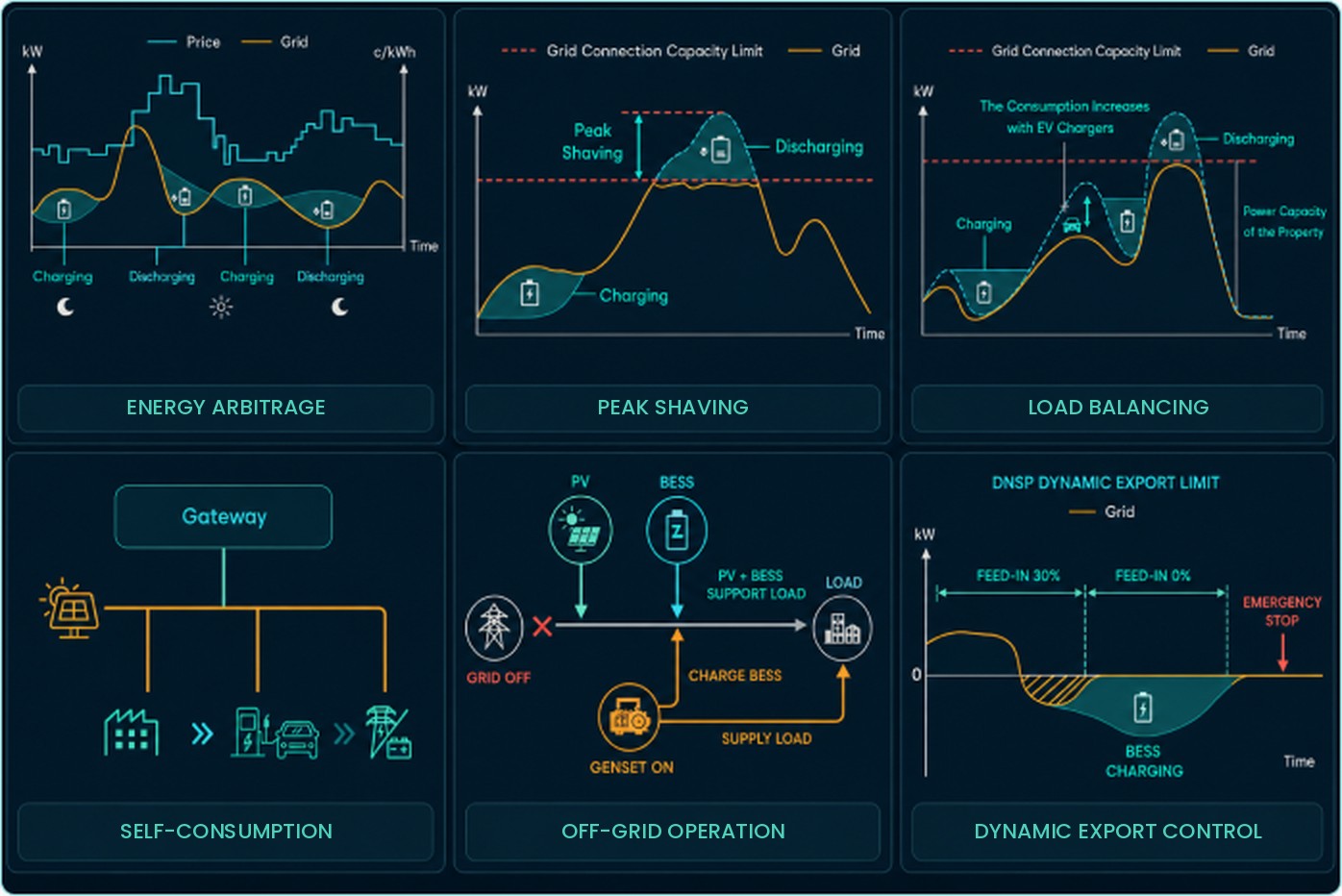
A fixed charge-discharge schedule is set once and goes stale. AI Mode keeps re-learning your load, your weather and your tariff, and re-plans every day across six dispatch strategies at once. The difference is measured against a documented baseline. Every site is modelled individually before we give an estimated additional saving from AI Mode.
Every day the optimiser takes four kinds of input: forecasts for load, solar and price; commercial signals like tariffs and demand charges; the state of your assets; and the site's hard limits. What it does with them depends on your objective, which comes out of your own bills and interval data when the system is designed in Ampaura Designer. A site chasing energy independence is weighted differently to one chasing the lowest bill: where exporting and shaving the peak compete for the same stored kilowatt hour, AI takes whichever returns more.
The plan is checked by the Ampaura Gateway against local safety and device limits before anything executes. Cloud thinks, the site verifies.

Arbitrage when prices swing, peak shaving when demand builds, load balancing when EV chargers stack up, self-consumption when the sun is out, off-grid when the network is not, and dynamic export control when the DNSP asks. The optimiser picks the blend, day by day.

Before AI Mode switches on, the system's performance under a standard strategy becomes the documented baseline. Every claim after that is the measured difference between the two, on your meter data, over a stated period. If a number ever comes without its site, period and basis, it did not come from us.
Send us twelve months of interval data and we will show you what AI Mode would have found in it. If the answer is not much, we will tell you that too.